Letter from Jane Hargreaves, former FAS Trustee

In the 1990s, Jane Hargreaves was a trustee of the FAS and took great care in developing the collections. We asked her to write her memories of working with the collections, and here they are in the form of a letter….

Hi Debi,

You said that I had obviously felt very strongly about the Women’s Caravan of Peace which Dora Russell took to the communist bloc countries of East Europe at the height of the cold war in 1958. Yes I do feel awed – principally because they went at a time when women had very little autonomy. I had that same feeling of admiration when I came across a small archive of a young PE teacher called Barbara Dodds who went out to the then colonial Kenya in the 50′s to be in charge of physical education for girls country-wide. Barbara immediately interpreted this to mean for all girls regardless of ethnic group or social disadvantage. She later travelled worldwide as an activist for women’s peace groups. Both of these archives are really outside the remit of the FAS in that the origin of ‘second wave ‘ feminism is reckoned to be in the late 60′s and reform did not become revolution until the 70′s. But they chime with me.

I arrived at the FAS in the 90′s having retired from teaching. I had been deeply involved in creating a policy of equal opportunities at the school where I had taught. I had helped to institute and been part of a team delivering the highly successful Professional Development for Women Teachers course. I thought I knew what feminism was. Now I found this amazing mound of dusty papers and books and periodicals piled up in the corner of the FA room presenting whole new aspects of feminist history.

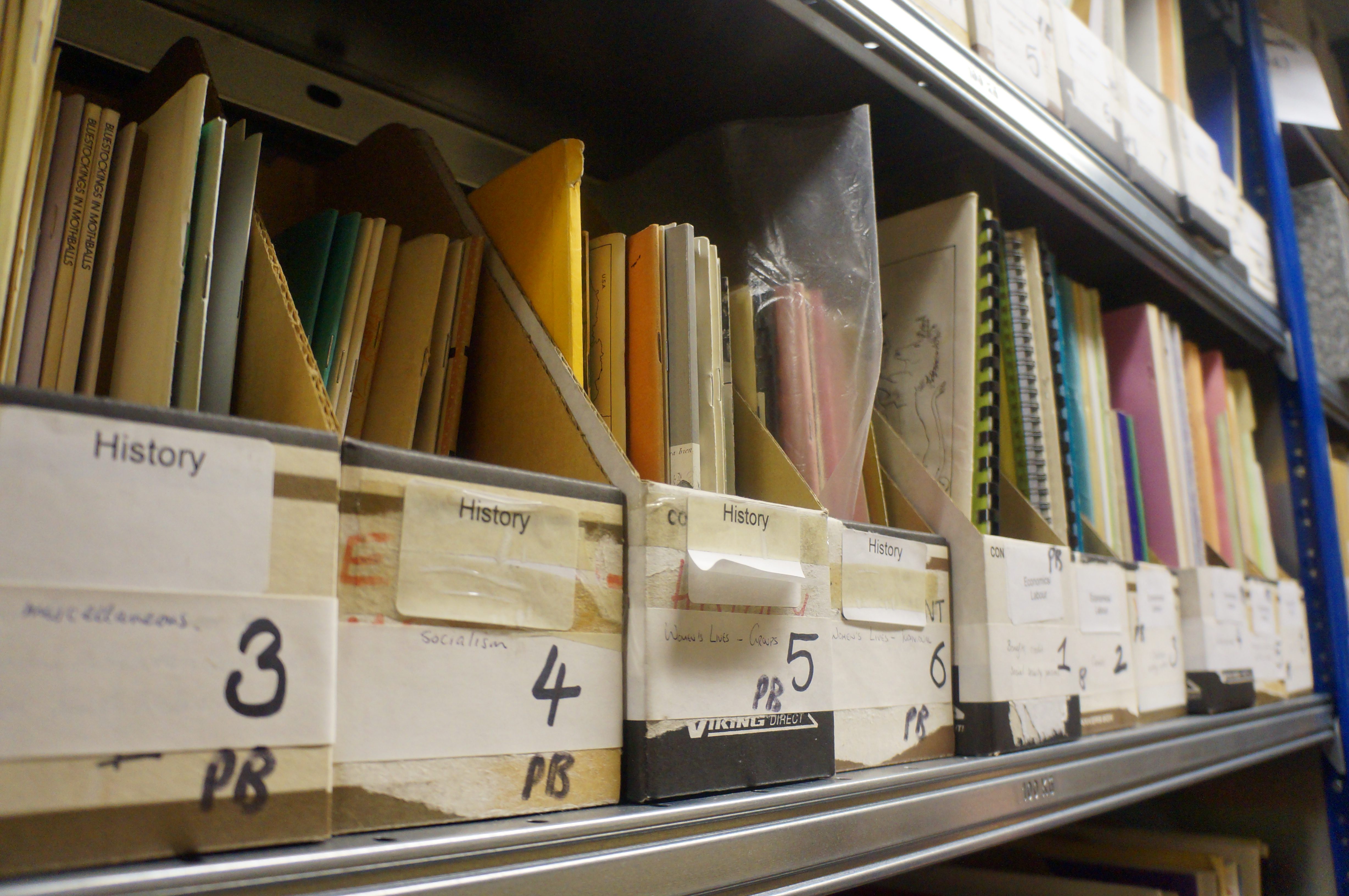
So I fell upon the books and discovered Mary Daly and Gyn/Ecology. I revelled in her use of language and her excoriation of ‘Godfather’ theology. And then I came across Fran Hosken and was shocked by her exposure of female genital mutilation and angered that in the 30 years since she wrote it so little has been done to eradicate this. On the lighter side I had a choice of the complete set of novels from Virago, the first all-woman publishing house. I laughed at Cath Tait cartoons. I revelled in the art work in the two boxes of book jackets from the earliest days of the Women’s Press. I found lovely prints by Monica Sjoo and drawers full of posters ranging from women’s theatre to political campaigns. There were striking prints by Pen Dalton. I am not likely to forget ‘Women are Revolting’ or ‘Free Castration on Demand’. We spent happy hours photographing posters and badges and putting them on our old website which was up and running as early as 1997.

There were friendships to be made. Just when I thought that nobody would ever look at the Dora Russell archive up popped a German-Portuguese researcher. Then Margaretta Jolly researched women’s letters and gave us a new computer! And when I had finally sorted out most of our Greenham Peace Camp holdings, Holger Terp, a near-blind researcher from Denmark, began a quest for songs from Greenham and for a heady time we were crisscrossing sources until his site had as complete a collection as he could make it.  Archif Menywod Cymru/Women’s Archive of Wales showed welcome sisterhood.  IIAV (the Dutch international women’s archive) in Amsterdam were practical and generous. I had a mindboggling time getting to grips with their international Women’s Thesaurus and this led to me reorganising the classification system in the FAS for the second time. That is the prosaic reason that all the labels are scrawled over and rewritten two or three times. Not neat but I hope effective!

The reclassification led me to look at the various papers scattered around under the loose heading of ‘abortion’. We managed to trace a history of abortion law reform in these papers from the 1967 Act to the discussions about embryo research in the 90′s. Together with articles in periodicals and pamphlets these are records of the steadfast campaigning of abortion law activists both locally and nationally. For me they were a reminder of the repressive atmosphere and hypocrisy of the 50′s.

Most women know of the legendary Spare Rib magazine. There is a complete set in FAS. But there is also a huge (unpublished) box of letters to the editor; not for general readership, but perhaps the time is right for restricted research. What else? There is a music collection on vinyl and an audio collection on tapes which may be disintegrating before examination. The collecting phase at FAS will largely be over when the pivotal Ellen Malos archive has been accessed. Now it all needs to be understood and interpreted by a different generation.

Ellen Malos & Germain Greer on Women and Waugh – This Thursday, 7pm @ MShed

The next Feminist Archive South workshop in this Thursday, 23 May, 7pm at MShed.

We will be watching a TV programme featuring Ellen Malos and Germaine Greer, who appeared on the discussion show Women and Waugh in 1984.

Ellen on Women and Waugh

The programme is fascinating not only for the issues the women discuss, but also for how Germaine and Ellen subvert how women are set up against each other in discussion shows as a form of public entertainment – the name of the programme itself is a pun on this, presumably!

Ellen and Waugh

The programme is also worth seeing for the sheer range of facial expressions Germaine Greer pulls, contrasted with the demure intelligence of Ellen.

Germaine Greer

Join us! Its free to attend, all welcome, and we will have a discussion about the issues raised in the film afterwards.

Action Photos from the Feminist Print Media Workshop!

Last Sunday we held the second Feminist Archive South workshop which explored the history of print media in the Women’s Liberation Movement.

After a brief tour of magazines such as Spare Rib, Shocking Pink, Red Rag and Bad Attitude, newspapers such as Outwrite and Shrew, Enough: The Journal of Bristol Women’s Liberation and Fowaad! the newsletter for the Organisation of Women of Asian and African Descent, we leapt into action and made our own publication.

A trip to a local stationery store is planned to reproduce it, and copies will be available at future workshops!

zine 12 zine 4 zine 3 zine 11  zine 5 zine 6 zine 8 zine 2 zine 10 zine 16  zine 7 zine 9

zine 14

zine 17

Zine 1

Archive Workshops – Now Full!

Due to a fantastic response to the call for participants for the archivist shadowing workshops, all the places are now full!

Thanks to all who have booked a place and expressed interest – its really encouraging to know that there is an audience and need for these activities, it helps us for future funding bids.

Big apologies though to anyone who has missed out – we promise to run similar programmes in the future.

Workshop information 9 June

While the next Feminist Archive South workshop is this Sunday, 11 May from 1-5pm at Mshed and will explore the history of feminist print media, we have details of another workshop below….

Sunday 9 June 2013 @ MShed 1-5pm. All welcome.

Bristol: Voices from the Women’s Liberation Movement facilitated by June Hannam and Kath Holden from the  West of England and South Wales Women’s History Network.

Most women took part in ‘second wave feminism’ at a grass roots, local level. How do we find out why they became involved and what they hoped to achieve? Can we recover their voices and, if we do, how can we interpret them?

This workshop will look at different ways that historians can try to recover women’s voices. The first part will look at documentary evidence, including newsletters, pamphlets and photographs. The second part will focus on oral testimony: participants will be invited to compare  summaries, full transcripts and original recordings of interviews.  The workshop will explore memory and the ways in which participants construct different stories of the movements in which they took part.

June Hannam is an emeritus professor and Kath Holden a visiting research fellow in history at the University of the West of England. They are co-chairs of the West of England and South Wales Women’s History Network. They both have research interests in  gender history. June Hannam specialises in labour and feminist history and Kath Holden in oral history and history of the family.

Recent publications include Katherine Holden: The Shadow of Marriage: Singleness in England, 1914-1960 (2007) and June Hannam, Feminism (2012).

Archivist cataloguing update – April/ May

Sarah Cuthill, the project archivist, is sharing the process of cataloguing Ellen’s archives for this blog. This is her first report….

The first month, about half of which was spent at Ellen’s house, where the papers were in much better order than anticipated! Originally covering the floor and tables of the first floor lounge, the archive comprises journals, business files, research papers, conference papers, badges, correspondence and ephemera such as fliers and posters for relevant events. Most of the papers were in folders or in homemade magazine files made by Ellen out of washing powder boxes. Eventually I boxed the collection up into cardboard grocery boxes from our local organic shop.

Collection Notes

Ellen quietly added extra piles of papers over the days. It was a boon, and a novelty, to have the owner of the papers there with me to explain how various organisations grew out of each other and where she was involved. As well as Ellen’s own research, there are important runs of papers relating to Women’s Aid and the Women’s Centre. We spent one morning with Ellen giving me a potted history of her life since coming to Bristol. My primary mission in these first weeks has been to survey the papers and make a quick list of what is there I did this with pencil and paper which I then typed up at home.

A selection of boxes
Two and half weeks in, we transferred the papers to my house in 18 cardboard boxes. The next step is to arrange the papers into logical categories, and to rebox them. This is to be done with the help of archive shadowers who will join in and learn about the archive as well as the archive process.

Boxes of Ellen's stuff

Feminist activism – temporary, invisible, documented

Feminist activism is often omitted from histories, and the majority of mainstream media. One of the main reasons why the Feminist Archive was set up was to ensure that there is a safe, secure place where documentation of feminist movements can be collected so they are less likely to be forgotten.

Feminist activism can of course take many forms. But it is those activisms which are underground, subcultural and temporary that are particularly at risk from erasure from the history books.

This photo of a vibrant piece of graffiti located at the St Werburghs-St Pauls underpass near the M32 junction taken on 5 May 2013 with a smart phone, encapsulates all these aspects of feminist activism.

Colourful piece of graffiti that says 'Stop Violence Against Women'

It is likely that this image, which has clearly been made to capture the attention, to force passer-bys to look again as the combination of text and colour emits a message of hope and social transformation, will be washed away by the council at some point in the next few days, weeks or months.

It will leave no physical record that can continue to tell the story of how this piece graphic communication intervenes into public space, and defiantly offers an alternative to the messages that are paraded on billboards, encouraging nothing more than a culture of excessive consumption and economic exploitation.

Everyday mobile technologies like smartphones (which of course are intimately bound up with capitalism), are tools to document these brazen messages that offer people the chance to dream, hope, live and create otherwise.

If you see other examples of feminist graffiti, please send them in and we can share them on this site.

The FAS on Shout Out

Feminist Archive South Trustee Deborah Withers was the guest on Bristol Community FM‘s LGBT radio show Shout Out on Thursday 25 April 2013.

She talks about the current workshop programme, and the wider Heritage Lottery Funded project to catalogue Ellen Malos’ archives.

Monica Sjöö talks to Helen Taylor about being a woman artist in 1973-1974

In 1973 and 1974 Helen Taylor and Brenda Jacques decided to embark on an innovative way of information sharing amongst feminist groups in Bristol. They stated: ‘it seems that the small weekly groups and specific campaign groups within Bristol Women’s Liberation don’t really know what the others are doing. Our only means of communication is through the newsletter which, though informative, can only give an outline of each group’s activities, and can suggest little of the feelings and experiences of the women involved.’

Their answer to this problem was to create a tape-slide and audio presentation that would be used in groups and on Radio Bristol’s ‘Access’ programme. They took photos of the Bristol Women’s Liberation activities and asked women the following question: ‘What difference has the Women’s Liberation Movement made to you in your daily life, in your relationships, your day-to-day routine, & your feelings about yourself as a woman, as well as your political awareness and activism?

One of the women they interviewed was Monica Sjöö, who died in 2005. In the extract below she talks about being a woman artist and the difference that women’s liberation makes.

Monica Sjoo stands in front of her painting